Replacing stock 392 battery

Interesting. The alternator should be able to put out around 200 amps and your compressor should max out at 60 amps if you have the top of the line ARB dual. Anyway, glad you are getting a battery under warranty.
At idle, an alternator does not put out anything close to its amperage rating. The higher an alternator's rotational speed, the more capable it is in producing amps. When at a red light much more reliance is put on the battery to maintain system draw/current. When cruising down the road the battery is re-charged.

An assumption, by the time ketanladd got to the 3rd tire, the battery no longer had sufficient stored amperage to support the compressor's load. IF in conjunction with a poorly performing battery, I can see a compressor lowering the minimum operating voltage & amperage required to keep the Jeep from going into a 'protect mode'... and stalling out.

Fact. The higher the voltage, the less amount of amperage a device pulls to support its optimal functionality. Just for example... an audio amplifier that can operate between 10 and 15 volts will draw much less current from the battery (thus reducing alternator load) at 15 volts. At 10 volts much more current is pulled to maintain optimal device functionality, killing a battery's stored power even quicker. And of course current or amperage creates heat which creates even more resistance, further putting a charging system into a pretty quick No-Go downward spiral, to include blowing fuses. Same holds true, a compressor running with an insufficient power supply will do the same.

(Perhaps next time use the Tazer's winch mode to keep the alternator's speed up? 🤷‍♂️ )
 
At idle, an alternator does not put out anything close to its amperage rating. The higher an alternator's rotational speed, the more capable it is in producing amps. When at a red light much more reliance is put on the battery to maintain system draw/current. When cruising down the road the battery is re-charged.

An assumption, by the time ketanladd got to the 3rd tire, the battery no longer had sufficient stored amperage to support the compressor's load. IF in conjunction with a poorly performing battery, I can see a compressor lowering the minimum operating voltage & amperage required to keep the Jeep from going into a 'protect mode'... and stalling out.

Fact. The higher the voltage, the less amount of amperage a device pulls to support its optimal functionality. Just for example... an audio amplifier that can operate between 10 and 15 volts will draw much less current from the battery (thus reducing alternator load) at 15 volts. At 10 volts much more current is pulled to maintain optimal device functionality, killing a battery's stored power even quicker. And of course current or amperage creates heat which creates even more resistance, further putting a charging system into a pretty quick No-Go downward spiral, to include blowing fuses. Same holds true, a compressor running with an insufficient power supply will do the same.

(Perhaps next time use the Tazer's winch mode to keep the alternator's speed up? 🤷‍♂️ )
You are correct even if you didn't say it. I was not thinking about the lower amperage put out at idle. Still seems very strange that the engine would shut down. A google search shows that an 85 amp alternator may put out 60 amps at idle. So, reduced but not by much. A winch definitely needs all the amps it can get but I dont see an air compressor using that much power.
 
You are correct even if you didn't say it. I was not thinking about the lower amperage put out at idle. Still seems very strange that the engine would shut down. A google search shows that an 85 amp alternator may put out 60 amps at idle. So, reduced but not by much. A winch definitely needs all the amps it can get but I dont see an air compressor using that much power.
Hello Viking Jeeper, I hope you don't think that I'm trying to be 'right' on this forum, lol. Really, I learn things all the time on here... and sometimes/many times I'm corrected. It's all about partnering to learn, at least for me it is :)

The only reason I can really speak to batteries & alternators is because once upon a time I use to be into SPL competitions. So, POWER was an important thing for me, and it was an expensive hobby, so I always tried to get it right LOL . E.g. 800-amp HO alternators, 5,000-amp batteries, etc...

With that I'm thinking the 60 amps at idle for an 85-amp alternator is being very generous. 60 amps sounds sorta ok when the alt is still cold, but once it gets hot forget about it, realistically it might be able to handle 30-35 amps at Idle. When hot, the alt would probably produce ~60 amps at mid to high RPMS... and to get near 85 amps you're pushing high engine RPMs.

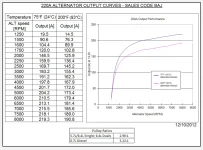
Please reference the attached curve graph for a 220A alternator and notice how much alternator speed & heat affect amperage output. (I pulled this from a Ram Truck site, but it had the 6.4 L so I grabbed it.) Note: This is at 14 volts, so the amperage outputs are on the generous side.

✌️
 

Attachments

  • 220 Amp Alt Output Specs.webp
    220 Amp Alt Output Specs.webp
    80.3 KB · Views: 60
Hello Viking Jeeper, I hope you don't think that I'm trying to be 'right' on this forum, lol. Really, I learn things all the time on here... and sometimes/many times I'm corrected. It's all about partnering to learn, at least for me it is :)

The only reason I can really speak to batteries & alternators is because once upon a time I use to be into SPL competitions. So, POWER was an important thing for me, and it was an expensive hobby, so I always tried to get it right LOL . E.g. 800-amp HO alternators, 5,000-amp batteries, etc...

With that I'm thinking the 60 amps at idle for an 85-amp alternator is being very generous. 60 amps sounds sorta ok when the alt is still cold, but once it gets hot forget about it, realistically it might be able to handle 30-35 amps at Idle. When hot, the alt would probably produce ~60 amps at mid to high RPMS... and to get near 85 amps you're pushing high engine RPMs.

Please reference the attached curve graph for a 220A alternator and notice how much alternator speed & heat affect amperage output. (I pulled this from a Ram Truck site, but it had the 6.4 L so I grabbed it.) Note: This is at 14 volts, so the amperage outputs are on the generous side.

✌️
I did not take offense at all, hope you did not either. Just trying to find a reasonable answer and I think you are also. The chart you sent is interesting. It does say "alternator RPM" rather than engine RPM but gives a pully ratio as the alternator is turning at higher RPM than engine. If the engine is turning 775 RPM the alternator is turning 2250 RPMs and at that rate should be producing between 134 and 159 AMPS. Am I reading that right?
 
I did not take offense at all, hope you did not either. Just trying to find a reasonable answer and I think you are also. The chart you sent is interesting. It does say "alternator RPM" rather than engine RPM but gives a pully ratio as the alternator is turning at higher RPM than engine. If the engine is turning 775 RPM the alternator is turning 2250 RPMs and at that rate should be producing between 134 and 159 AMPS. Am I reading that right?
Well Good Morning Mr Jeeper :)
I assume "Mr" as I'm trying to focus in on your banner picture, LOL. Pretty cool pic by the way!

You are absolutely correct with your calculation. 136 - 159 amps at 750 engine RPMs (or 2,250 alternator RPMs). That graph however was to display the relationship between heat (ohms) and amperage output, since that graph had the 6.4L I grabbed it [perhaps I should not have] ...and I suspected that may make this more convoluted IF you actually looked into it. And you did do your homework, so kudos to you! :cool: (y)

Here's the issue. I pulled that graph from a RAM Truck site. To figure out how or if the graph would apply to a Jeep 392 with regards to amperage output, I would need to know three variables. 1) The harmonic balancer/crank pulley size. 2) The alternator pully size. 3) The specs on our specific alternator, as alternators all produce varying amperage outputs even at the same alt RMP.
I did a search, but 392 data is very limited especially when really trying to get into the weeds on this stuff. (If anyone knows, please share.)

On the other JL Wrangler site there was conversation regarding the trailer tow package which led to the 220-amp alt verse the 240-amp alt. Again, applicable to the other Wranglers, but potentially applicable to ours as well.
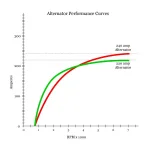
There was an Alt Performance Curve graph there, though I can't cite the data so please don't beat me up, LOL. My intuition tells me it looks pretty accurate, but it does not identify cold vs. hot operating performance; however, it does utilize engine RPM verse alt RPM. So, it's a little more straight forward.

The red & green lines could be a little thinner but when magnifying the picture, it looks like the engine RPM starts off at ~750. When tracing the green line/220 amp alt line and sliding straight up, it appears that at 750 RPMs the amperage is holding good up to about 30 - 35 amps*, then it curves out of tolerance. On a side note, as I'm thinking about this, I have to assume this is at normal operating [hot] temperature, but only because my senses lean me that way, I could be wrong. It also makes sense as when my Tazer idles up to 1250 [if I recall correctly] in winch mode, it provides 90 - 100 amps.

* I'm not certain which ARB compressor kettanlann has, but the amperage draw varies from 12 to 50 amps at 72 degrees fahrenheit with the different ARB models. With a failing battery the lack of available power issue would compound as its ability to maintain voltage degrades; thus, more amps is required to power the compressor. Again, the lower the voltage the more amps that are required to power any electronic device. If your alternator is displaying 14 volts with a multimeter that does not mean your failing battery is storing 14 [or 12.6] volts for any real length of time.

Hopefully I didn't make this more confusing 😩 But I do appreciate the conversation. It certainly beats talking to my girl about her vegetable garden in the back yard 🤫. I'll deny it if you tell her I said that! LOL
 

Attachments

  • alternator-performance-220v240.webp
    alternator-performance-220v240.webp
    16.9 KB · Views: 38
  • ARB Specs.pdf
    ARB Specs.pdf
    50.4 KB · Views: 67
Engine turning over slow last few weeks and been getting the "aux switches not available, battery charging" warning more and more frequently. Thinking bad cell in battery. Going to to dealer today. Took delivery 1/22 and have 27k miles now. No other problems to date. Do have Tazer but seems unrelated as I've had it since almost new. Warning now showing up sometimes when jeep was parked <1h.

Initially the lady on the phone said the battery was not under warranty. I told her my understanding was 3y/36k miles. She offered to give me the number to mopar to confirm. I just googled it and it says 3y 36k miles. Will see.
 
Engine turning over slow last few weeks and been getting the "aux switches not available, battery charging" warning more and more frequently. Thinking bad cell in battery. Going to to dealer today. Took delivery 1/22 and have 27k miles now. No other problems to date. Do have Tazer but seems unrelated as I've had it since almost new. Warning now showing up sometimes when jeep was parked <1h.

Initially the lady on the phone said the battery was not under warranty. I told her my understanding was 3y/36k miles. She offered to give me the number to mopar to confirm. I just googled it and it says 3y 36k miles. Will see.
Just replaced mine under warranty due to the same messege and slow yo turn over. They will most likely need to keep it overnight to run the test.
 
So battery passed test. Still get message. Service guy said battery probably starting to go bad and bring it back in a week or two. I'll wait until battery is really bad or right before 36k miles. Will keep posted. I think the 392 is probably pretty hard on batteries
 
Last edited:
I pulled the trigger and installed the Antigravity H7/Group-94R Lithium Battery - 80Ah. Caught it on sale for 10% off. My review:
Con: Expensive.
Pros: Engine start up (turns over fast); Battery life; Rock Slide Steps never dead/slow; Aux Switches don't shut off from low battery from normal use of accessories with engine off; Great for heavy load from aftermarket amps; Easy install; Lighter weight; Obvious quality;
 
I pulled the trigger and installed the Antigravity H7/Group-94R Lithium Battery - 80Ah. Caught it on sale for 10% off. My review:
Con: Expensive.
Pros: Engine start up (turns over fast); Battery life; Rock Slide Steps never dead/slow; Aux Switches don't shut off from low battery from normal use of accessories with engine off; Great for heavy load from aftermarket amps; Easy install; Lighter weight; Obvious quality;
Did it come with their jump start feature ? I wonder how well they will handle cold weather ?
 
I went ahead and put in a AGM Everstart from walmart with 4y warranty for $180. No more slow turning over. No more aux switch not working battery charging warning. Don't know how the other battery passed test, but worth $180 to have problem fixed and not waste another day with jeep dealer for them to test the still functioning, but clearly weak factory battery.
 
I went ahead and put in a AGM Everstart from walmart with 4y warranty for $180. No more slow turning over. No more aux switch not working battery charging warning. Don't know how the other battery passed test, but worth $180 to have problem fixed and not waste another day with jeep dealer for them to test the still functioning, but clearly weak factory battery.
That's more in my price range. ;)
 
I ordered an optima yellow top h7 hope it's as good as they say
 
Hey folks. My 2021 392 has a dead battery. I’ve tried to jump it, charge it, and it’s not taking anything. I pulled it out this morning and put it on my ctek (7002) and it’s acting like it’s charging. But I’m not so sure it’s going to work out in the end. I don’t have a way to load test, but I can take it to a parts store I guess. In my experience if the battery is low, the load test isint valid anyway.

Long story short. I k ow I’ll get some different responses. But what is the go to battery that’s an upgrade from stock? If my battery doesn’t take a charge, and I’m forced to replace… I’d like to put a battery in it that is fit for the 392.

Thoughts?
Odssey. These are great batteries. They out crank and outlast anything out there. I personally own about 20 of these in various cars, trucks and other vehicles. I started a built 6068 John Deere diesel in a boat with a small Odessey motorcycle battery in an emergency once. Older Harleys eat up most batteries in a year or two. Odyssey’s last for 7-10 years, and, crank them over quicker. The Anti Gravity (own two) are light; but, stupid $. Have a small Odssey that starts a 750 HP big block Chevy in a Boss Hoss that needed some extra room under the seat where the original full size car battery was.. When my original batteries die in my 392 and diesel Jeep’s, Odsseys. will replace them
 
I pulled the trigger and installed the Antigravity H7/Group-94R Lithium Battery - 80Ah. Caught it on sale for 10% off. My review:
Con: Expensive.
Pros: Engine start up (turns over fast); Battery life; Rock Slide Steps never dead/slow; Aux Switches don't shut off from low battery from normal use of accessories with engine off; Great for heavy load from aftermarket amps; Easy install; Lighter weight; Obvious quality;
What about charging, no issues with over charging?
 
This is exactly my next step on weight reduction! Did you do a weight comparison to the stock battery by any chance or know how much the lithium battery weighs?
 
This is exactly my next step on weight reduction! Did you do a weight comparison to the stock battery by any chance or know how much the lithium battery weighs?
Weight depends on which Antigravity battery you buy. I got the 80 amp.

A typical Group 94 AGM is about 53 lbs. With the large Antigravity, weight savings is about 28 lbs. You can definitely tell the difference during install because the OEM battery takes effort to remove.

H7-40-RS​

40 Amp Hours​

1500 Cranking Amps
15.6 lbs

H7-60-RS​

60 Amp Hours​

1800 Cranking Amps
18.5 lbs

H7-80-RS​

80 Amp Hours​

~2000 Cranking Amps
25.5 lbs
 

Create an account or login to comment

Join now to leave a comment enjoy browsing the site ad-free!

Create account

Create an account on our community. It's easy!

Log in

Already have an account? Log in here.

Latest Discussions

Back
Top