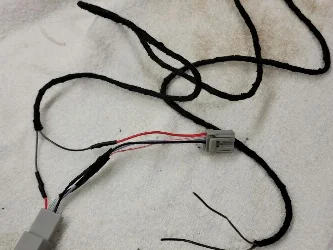
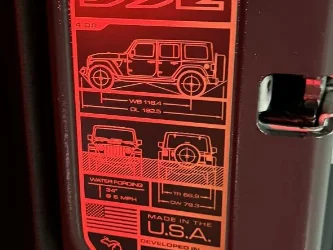
Towing with my 2025 392. Thoughts?

Haven’t received my new 392 yet, but the 2021 JLs have a 12v source in the rear cargo area. Wouldn’t that be an easier pick up point to power the brake controller? Is the front power option so you can mount a manual override? I’ve used brake controllers before and they’re pretty much a set it and forget it device unless you’re hugely varying your tow load. I’d mount it in the back, do a few test runs to set it, then forget about it.
Based on my research, along with validation from Chrysler, the Red Arc tow pro appeared to be the best fit for my needs. As far as mounting the controller up front, I prefer to have complete control of my trailer brakes while in motion. Like many OEM electric brake controllers, you can set and test the trailer brakes without using the truck brakes. This is to determine the appropriate braking medium between the pulling unit and the trailer. Also, it's good to test your trailer brakes a few times a day or more to make sure they're working correctly. First thing I do every morning, I am towing, is to conduct a thorough walkaround and test the lights and brakes—old trucker habits. Thanks
 
The Jeep Wrangler 392 has a very good drive train, enhanced frame excellent oversized brakes and super axles. The transmissions is also strong enough for towing.

Here's where the rub is, the 392 is a hot running beast that needs a great deal of cooling to keep it happy, unfortunately the cooling system is just not up to the task of towing and the primary reason Stellantis kept the towing rating on the 392 to 3500 lbs. I thought by now the Gladiator would be released and if Stellantis plans on selling any of them there going to need to be able to tow well over 5k if they want to sell them in the mid size truck market where 7700 is about the standard, and currently the 3.6 Gladiator is rated at the same. It would be stupid to try to sell a Gladiator that is only capable of towing 3500lbs.

With that said Stellantis is going to have to figure out how to accomplish a cooling upgrade for the 392. This is no easy job, even the new 392 Moab is only rated at 3500k, so to me its obvious they haven't figured out how to do it. This is also probably the reason why the new 392 Gladiator hasn't dropped yet.

When you look at the small cooling area you have to work with a massive multi core radiator is going to be necessary with one heck of a fan system to pull in lots of cool air, add to that transmission and engine oil coolers and it no simple task. This one is going to keep Stellantis engineers up at night trying to solve this and still shoehorn in a 392!

Not to rain on your parade, if it was up to me I would pick up a used 1/2 or 3/4 ton short bed truck and forget using the 392 Wrangler. It's going to be a bunch easier and give you better results, true is won't be as much fun.
Well, you were right about the heat. Here are my towing highs: Coolant 332, Trans 206, oil 364 F. Most of the time, the temps were 10-15 degrees lower. I kept it at 55-65 and only ran the AC occasionally. 3,200 miles total, with some pretty steep hills in Idaho. I've been checking the temps without the trailer, and the oil still runs almost 330 degrees F at 75 with the AC. I must admit it ran well even with the crazy temps.
 
I just got back from a trip from Albuquerque, NM, to Lewiston, ID, and back, towing my ATC Sto350 trailer. Smiley, Wry Fox, and Earl warned me about the heat, and they were right—it got pretty hot out there. The trailer weighed about 2,700 pounds, and the total weight was 9,625 pounds. Since the trailer is about 9 feet tall, it definitely has some wind resistance. I covered almost 3,200 miles with the trailer. I kept an eye on the temperatures and sometimes turned off the AC to help. Here are the highest temps I saw: oil hit 364, coolant reached 232, and transmission reached 199. On flat stretches, temps were usually 10 to 15 degrees cooler. The highest readings happened while climbing, especially with the AC on. If the truck dropped down two gears on a steep hill, the temps would shoot up fast. Still, everything ran great with no problems. When I got home, I changed the oil and noticed it was pretty black after just 4,000 miles. I’m looking for some cooling solutions even though it's still under warranty. Thanks
 
If your concerned about warranty issues and better cooling for towing, then you would need to decide one or the other. Because the PCM is locked. I have done all this stuff that I'm listing.
1. Changed to a 180 degree thermostat.
2. Got a diablo tuner along with them unlocking the PCM.
3. Lowered the fan on temp to 195 normal driving. Changed to 180 when spinning it up on the sand dunes.
4. Removed the inline trans fluid thermostat and replaced with a pass through.

Newer vehicles don't require the AC off to cool down motor because it doesn't help and the newer style AC pump.

The oil is cooled by radiator fluid going through the oil filter adapter. I am going to change to an actual oil cooler setup when I get all the pieces and parts.
 
If your concerned about warranty issues and better cooling for towing, then you would need to decide one or the other. Because the PCM is locked. I have done all this stuff that I'm listing.
1. Changed to a 180 degree thermostat.
2. Got a diablo tuner along with them unlocking the PCM.
3. Lowered the fan on temp to 195 normal driving. Changed to 180 when spinning it up on the sand dunes.
4. Removed the inline trans fluid thermostat and replaced with a pass through.

Newer vehicles don't require the AC off to cool down motor because it doesn't help and the newer style AC pump.

The oil is cooled by radiator fluid going through the oil filter adapter. I am going to change to an actual oil cooler setup when I get all the pieces and parts.
I noticed that keeping the fan on full-time dropped all the temperatures to a very reasonable level. So I think the problem isn’t that the radiator isn’t big enough, it’s that air won’t flow through it because there’s nowhere for the air to go in that engine compartment. Now, when I tow, I just forced the fan on. It might be a good idea to do all the time. Someone shared a link to a device that regulates the fans speed based on temperature. I think that may be all we need. And maybe an external oil cooler if we can find a place to put it. There’s not a lot of room.
Like other said, it’s just not the best tow vehicle.
 
I noticed that keeping the fan on full-time dropped all the temperatures to a very reasonable level. So I think the problem isn’t that the radiator isn’t big enough, it’s that air won’t flow through it because there’s nowhere for the air to go in that engine compartment. Now, when I tow, I just forced the fan on. It might be a good idea to do all the time. Someone shared a link to a device that regulates the fans speed based on temperature. I think that may be all we need. And maybe an external oil cooler if we can find a place to put it. There’s not a lot of room.
Like other said, it’s just not the best tow vehicle.
Yah, I know. When I install my winch, I'm going to mess with installing the oil cooler setup. I've got the adapter already, and am waiting to see how/where I'm going mount the cooler when I get the bumper out of the way. I'll post the info when I'm finished.
 
Adding a aux oil cooler system will no doubt help the problem, removing the heat load from the radiator in coordination with a fan controller should really make a difference.

Minimum airflow and a small radiator charged with cooling the engine, oil and transmission fluid is just too much for the existing configuration.

I am not surprised Jeep didn't do this in the first place but I can understand why, COST!
 
Adding a aux oil cooler system will no doubt help the problem, removing the heat load from the radiator in coordination with a fan controller should really make a difference.

Minimum airflow and a small radiator charged with cooling the engine, oil and transmission fluid is just too much for the existing configuration.

I am not surprised Jeep didn't do this in the first place but I can understand why, COST!
I’m also curious about the Hydro guide inductionsystem. Because of the rubber flaps at the back of the Hydro guide, it’s dumping outside air into the engine compartment, which results in positive pressure, making it even harder for airflow through the radiator. One option to only be used when you’re certain there will be no rain is to tape the rubber flaps shut. Then the system works like a true induction system. Maybe even pick up 0.001 horsepower under full load and full throttle.
 
I’m also curious about the Hydro guide inductionsystem. Because of the rubber flaps at the back of the Hydro guide, it’s dumping outside air into the engine compartment, which results in positive pressure, making it even harder for airflow through the radiator. One option to only be used when you’re certain there will be no rain is to tape the rubber flaps shut. Then the system works like a true induction system. Maybe even pick up 0.001 horsepower under full load and full throttle.
Wow, Keith, Great thought! That's something that never crossed my mind, your right on with your assessment. Break out the duct tape for a test, just don't do it while your fording through some deep water, lol
 
If your concerned about warranty issues and better cooling for towing, then you would need to decide one or the other. Because the PCM is locked. I have done all this stuff that I'm listing.
1. Changed to a 180 degree thermostat.
2. Got a diablo tuner along with them unlocking the PCM.
3. Lowered the fan on temp to 195 normal driving. Changed to 180 when spinning it up on the sand dunes.
4. Removed the inline trans fluid thermostat and replaced with a pass through.

Newer vehicles don't require the AC off to cool down motor because it doesn't help and the newer style AC pump.

The oil is cooled by radiator fluid going through the oil filter adapter. I am going to change to an actual oil cooler setup when I get all the pieces and parts.
Learned something new. AC doesn't need to be off. Thanks
 
I just got back from a trip from Albuquerque, NM, to Lewiston, ID, and back, towing my ATC Sto350 trailer. Smiley, Wry Fox, and Earl warned me about the heat, and they were right—it got pretty hot out there. The trailer weighed about 2,700 pounds, and the total weight was 9,625 pounds. Since the trailer is about 9 feet tall, it definitely has some wind resistance. I covered almost 3,200 miles with the trailer. I kept an eye on the temperatures and sometimes turned off the AC to help. Here are the highest temps I saw: oil hit 364, coolant reached 232, and transmission reached 199. On flat stretches, temps were usually 10 to 15 degrees cooler. The highest readings happened while climbing, especially with the AC on. If the truck dropped down two gears on a steep hill, the temps would shoot up fast. Still, everything ran great with no problems. When I got home, I changed the oil and noticed it was pretty black after just 4,000 miles. I’m looking for some cooling solutions even though it's still under warranty. Thanks

It's good to know those numbers. When I towed up the gauntlet from Mesa, AZ to Payson recently this summer in the heat, I hit oil temps right at 300-305F, coolant ~220F, and trans is about 200-205F. That's when I'm giving her the beans up the hills. If I back it down some, it stays a little cooler. Those long, steep, hot hills are brutal for towing. No issues though. I can't really imagine towing over the recommended towing limit of these jeeps. No idea what they do to them to get the 5K tow rating, but I sure wouldn't go tow that much, rated for it or not.
 
I’m also curious about the Hydro guide inductionsystem. Because of the rubber flaps at the back of the Hydro guide, it’s dumping outside air into the engine compartment, which results in positive pressure, making it even harder for airflow through the radiator. One option to only be used when you’re certain there will be no rain is to tape the rubber flaps shut. Then the system works like a true induction system. Maybe even pick up 0.001 horsepower under full load and full throttle
I’m also curious about the Hydro guide inductionsystem. Because of the rubber flaps at the back of the Hydro guide, it’s dumping outside air into the engine compartment, which results in positive pressure, making it even harder for airflow through the radiator. One option to only be used when you’re certain there will be no rain is to tape the rubber flaps shut. Then the system works like a true induction system. Maybe even pick up 0.001 horsepower under full load and full throttle.
 
I’m also curious about the Hydro guide inductionsystem. Because of the rubber flaps at the back of the Hydro guide, it’s dumping outside air into the engine compartment, which results in positive pressure, making it even harder for airflow through the radiator. One option to only be used when you’re certain there will be no rain is to tape the rubber flaps shut. Then the system works like a true induction system. Maybe even pick up 0.001 horsepower under full load and full throttle.
Definitely food for thought. I was thinking that the extra airflow from the hydroglide would help by passing more air over the engine. I wonder if the air pressure passing through the cooling system at speed is greater than the air passing through the hydroglide. Dammit, LOL, now you've got me thinking.
 
I’m also curious about the Hydro guide inductionsystem. Because of the rubber flaps at the back of the Hydro guide, it’s dumping outside air into the engine compartment, which results in positive pressure, making it even harder for airflow through the radiator. One option to only be used when you’re certain there will be no rain is to tape the rubber flaps shut. Then the system works like a true induction system. Maybe even pick up 0.001 horsepower under full load and full throttle.
Hm, aren’t those flaps behind the engine with outlets pointing down between firewall and engine? I would have thought that actually creates “suction” over the transmission and transmission “tunnel” under the body thus helping extract hot air. If the flaps were in front of the engine then perhaps it would interfere with front airflow. Add aftermarket aluminum vented inner fenders (over plastic closed factory ones) for better heat dissipation perhaps?
 
Hm, aren’t those flaps behind the engine with outlets pointing down between firewall and engine? I would have thought that actually creates “suction” over the transmission and transmission “tunnel” under the body thus helping extract hot air. If the flaps were in front of the engine then perhaps it would interfere with front airflow. Add aftermarket aluminum vented inner fenders (over plastic closed factory ones) for better heat dissipation perhaps?
I agree. Without knowing how the system was designee for aitflow, it might be worse opening it up. Propping the flaps open or adding vented fender liners might create turbulence to the naturally airflow designed by a Jeep engineer. I’m sure there’s a computer simulated airflow diagram out there somewhere.
 
Lizard agrees with high under hood temperatures being a problem.
 

Attachments

  • IMG_1215.webp
    IMG_1215.webp
    124 KB · Views: 10
Even with our Pennzoil Platinum Synthetic oil temperature over 300 degrees is a real problem, this is the temperature that the oil begins to break down and oxidize and begins to drastically effect it's ability to protect the engine.

Bottom line if you are towing with your 392 keep a close watch on the oil temp, when it gets up to the 300 mark consider a food, potty or refuel break. Your differential will also thank you. If you exceed the 300 mark for a period of time also think about an early oil change. And even though the oil used in our 392's is not cheap it's much better then decreasing the life of your engine.

I do hope some aftermarket companies will jump on the bandwagon and offer an override solution that is plug and play and will not void the warranty! (and the tazer solution simulating a trans overheat is not the answer)
oiltemp.webp
 
Last edited:
The 392 tows fine with the setup the OP was talking about.

If you have the tow package, the break controller is a 30 minute install and the airbags are an easy (2-hour) install. The hardest part is in deciding where to mount the valve(s).

And for the record, I have one 392 with the setup the OP has described (on 37s) and another 392, on 1-tons, 40’s, and coilovers, that regularly tow my 3,500 (empty) Opus 4 trailer… in Colorado, Arizona, and Utah, with zero problems.

IMG_3842.webp
 
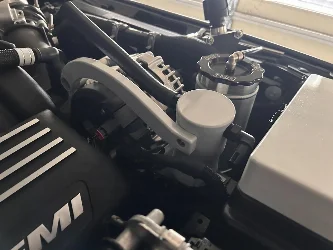
I’m starting to research aftermarket oil coolers. Does anyone have experience with these and HEMIs? So far research points me to Derale sandwich plate with thermostat. My dilemma is what cooler, mount location - concerned that airflow will be reduced if I mount in front of the main radiator
 
I’m starting to research aftermarket oil coolers. Does anyone have experience with these and HEMIs? So far research points me to Derale sandwich plate with thermostat. My dilemma is what cooler, mount location - concerned that airflow will be reduced if I mount in front of the main radiator
You have your work cut out for you, space in front of the radiator is a real premium. I thought about this before and considered a remote mounted oil filter with a Derale forced air cooler under the Jeep. Again a real issue especially if your running any kind of suspension body armor.

There is so little space available for upgrades like this and another reason I don't expect to see a Hemi Gladiator unless they use the cooler running 5.7, less displacement, less heat as well.
 

Create an account or login to comment

Join now to leave a comment enjoy browsing the site ad-free!

Create account

Create an account on our community. It's easy!

Log in

Already have an account? Log in here.

Back
Top