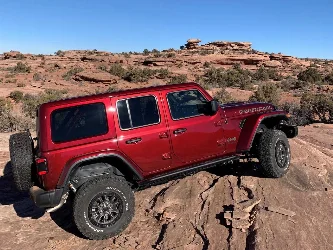
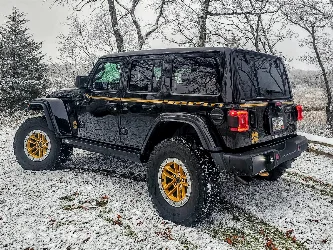
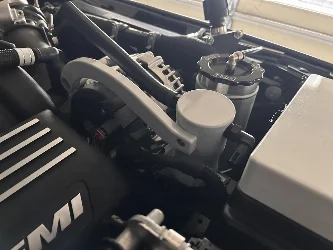
If you are looking for a 392 Camper

I disagree, but we are getting into personal opinions. Not gonna get into a point by point debate.

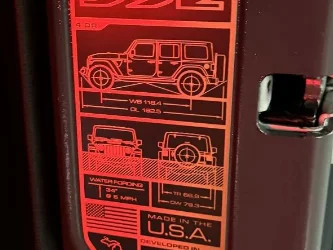
BTW, I would never tow 5000# behind my Jeep. I only pull empty. Stay under the legal stamp on your door and stay safe. There are legal (including insurance liability) going above your legal GVWR.

Anyway enjoy whatever makes you happy.
I would only tow 5000 lbs with my 392, Sway/Levelers/Weight Distribution, Trailer Brakes and Controller, short distances....not too far maybe 4-5 hrs at most to be honest...I have Alcon Brakes all the way around on my 392 as well...I tow a lot...over 100,000 miles with this 75 ft set up....two Quads and a RZR in the Toyhauler...Jeep in tow with Brakes as well...Load Range H Tires with 6000 lb Alcoa Wheels on 8000 lb axles on RV....3900 lb Hitch Weight....
DSC03101 (1).jpg
 
Last edited:
Towing capacity has always been a sticking point for me..... I'm not sure about the JL, but the JKU had something like a 5000 pound towing rating in Europe, but only 3500 in the US...

The difference in what you can do with 5000 versus 3500 is a pretty huge jump.

I always thought it was dumb, but I'd be concerned about the liability aspect of towing beyond the rated weight. Even an accident that was not your fault could put you into some serious liability that your insurance would probably not cover.
Yes sir, I'm anal about towing, I insure I have everything addressed down to the last detail...thats why I have towed 100's of thousand of miles and even made critical repairs on the road side that would boggle most folks minds...not scared of legalities either...not in the least...

My biggest concern pulling 5000 with 392 is the rear axle, nothing else comes into play...
 
Towing capacity has always been a sticking point for me..... I'm not sure about the JL, but the JKU had something like a 5000 pound towing rating in Europe, but only 3500 in the US...

The difference in what you can do with 5000 versus 3500 is a pretty huge jump.

I always thought it was dumb, but I'd be concerned about the liability aspect of towing beyond the rated weight. Even an accident that was not your fault could put you into some serious liability that your insurance would probably not cover.
I'm as puzzled as you are. Even the mostly false new rating for some JLs to tow 5000, but not for others. Seems like Stellantis just didn't want to spend money on new testing.

In EU I believe they have speed restrictions for towing, like max of 60km/h.
 
I'm as puzzled as you are. Even the mostly false new rating for some JLs to tow 5000, but not for others. Seems like Stellantis just didn't want to spend money on new testing.

In EU I believe they have speed restrictions for towing, like max of 60km/h.
The semi-float axle/axle bearings are the weak point, full floaters have two sets of bearings at the outer point on the axle next to the wheel, so this carries the weight without creating flexing stress on the axles, the Dana M220 Rear Axle we have is a single outer bearing and when loaded (tongue/hitch weight) it transfers this stress to the axles and bearing...the tongue weight is ok at 500 lbs, especially with weight distribution hitch, but when you start shock loading these axles and bearing configurations on rough roads, thats when it becomes and issue as the hitch load is multiplied at that point...


semi-vs-full-floating.jpg
 
Last edited:
The semi-float axle/axle bearings are the weak point, full floaters have two sets of bearings at the outer point on the axle next to the wheel, so this carries the weight without creating flexing stress on the axles, the Dana M220 Rear Axle we have is a single outer bearing and when loaded (tongue/hitch weight) it transfers this stress to the axles and bearing...the tongue weight is ok at 500 lbs, especially with weight distribution hitch, but when you start shock loading these axles and bearing configurations on rough roads, thats when it becomes and issue as the hitch load is multiplied at that point...


The 2024 JL Rubicons and 392 have full-float rear axles and are still rated @ 3500, except of a specific engine/wheel combo that's rated at 5000.

The JTs had/have higher towing ratings with semi-float axles.

There is no rime or reason for those rating, especially when there is already a JL rated at 5000 but not the 392. Perhaps Stellantis greed and/or laziness.
Oh theres a reason a weak link somewhere, on the 2023 and prior 392 it's the rear axle...upgraded chromoloy axles will be a good start...
 
Last edited:
So the JL model that's rated for 5000, and the JT's that are rated a lot more, have different axles?!? Don't think so.

Again, on the 2024 392 the rear axle is full float, which you listed as a must have. BTW, there are tons of other SUVs that have same wheelbase (even shorter), similar engines (V6s), semi-floats, and are still rated to pull a lot more that the JK/JLs. Like the pre unibody Nissan Pathfinder.

This is most likely due to Stellantis protecting its line of trucks than anything else. It screws us Jeep owners that want to tow within the "legal" GVW stamp. It might also be due to liability issues such as towing 5000# with a 5" lift on 40"s
I'm going to make a SWAG and say, it's the torque vs frame on 392, and/or transfer case thats the limiting factors for derating to 3500 tow weight...

Could be cooling capacity as well...another critical factor....engine and/or transmission....

JL axle tubes are 7mm thick vs JT’s 10mm

Another variable duly noted:
392 lower tow rating has to do with the standard 35” tire package. The 35’s introduce a lot more potential for sway problems especially on a short wheel base vehicle
 
Last edited:

2020 Jeep® Gladiator Rubicon
The Command-Trac 4×4 system, which is standard on Sport and Overland models, features a two-speed transfer case with a 2.72:1 low-range gear ratio, and heavy-duty third-generation Dana 44 front and rear axles with a 3.73 rear axle ratio.

On the Gladiator Rubicon, a Rock-Trac 4×4 system features heavy-duty third-generation Dana 44 front and rear axles with a “4LO” ratio of 4:1. A 4.10 front and rear axle ratio is standard as are Tru-Lok locking differentials.

“To meet the payload requirements, we went to the heavy-duty Dana 44 axles,” said Pete Milosavlevski, chief engineer.

The standard heavy-duty Dana 44 front and rear solid axles on the Gladiator also have extra-thick tubes and forgings for additional strength, rigidity and durability.

JL axle tubes are 7mm thick vs JT’s 10mm


Another variable duly noted:
392 lower tow rating g has to do with the standard 35” tire package. The 35’s introduce a lot more potential for sway problems especially on a short wheel base vehicle.
 
Last edited:
The extra weight of engine deducts from payload available but I’m still surprised the tow rating is 3,500#
 

Create an account or login to comment

Join now to leave a comment enjoy browsing the site ad-free!

Create account

Create an account on our community. It's easy!

Log in

Already have an account? Log in here.

Back
Top