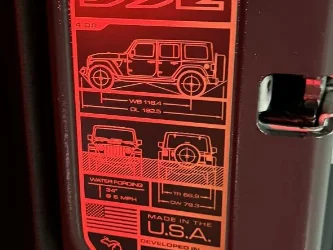
Go by the tire rating (stamped on sidewall).
door only reflects OEM. Every manufacturer and every model varies. They are all designed for a specific PSI for road driving, factoring in safety, wear, mileage and handling based on load
Honestly worse advice ever. Sorry, but when it comes to safety, I have to be honest. The pressure stamped on the side wall is maximum pressure at the maximum weight rating, and is the absolute maximum tire pressure for that tire on any vehicle. Does your Jeep weigh 10,000 pounds?
It has nothing to do with the recommended tire pressure on a Jeep Wrangler.
You’ll hear a lot of advice and ideas on how much tire pressure to run. And honestly, there’s no perfect solution.
Some may say to do the chalk test. It’s actually easier for us on our jeep with very little camber. Tried to slide a piece of paper under the tire. If you can slide the paper under the tire, it may be overinflated. Deflate until you can no longer slide the paper into the tire.
Using this method will maximize the contact patch. But it will cause someway in turns. So I would not go any lower than that on the road.
When you load up your jeep, you’ll have to add some more in the back. Likely not in the front.
When my 2024 Jeep Wrangler 392 was completely stock, I was running 28 in the front and 24 in the back to get similar contact patch on all four tires. Now that I have a lot of gear in the back, it’s actually 28 front and 34 rear. Big difference.
37 psi is way too much for our jeeps. That helped Jeep get some fuel economy numbers that they were looking for, but your Jeep will ride like

. You may slide to a stop, especially when it’s wet. Your wheels will bounce uncontrollably over bumps. If you hit a bump at highway speed, it will rattle your steering wheel and your teeth.


 17 psi for c rated 33 or 35 is good or 12-15 if it’s a nasty trail ( c rated). 10-12 for d or E rating 25 psi on road for D or E is also a sweet spot